Introduction
Understanding fertility is an important step for individuals and couples planning to have a baby. One of the factors doctors consider during a fertility assessment is ovarian reserve. It refers to the estimated number of eggs remaining in a woman’s ovaries and can provide useful information about her reproductive health.
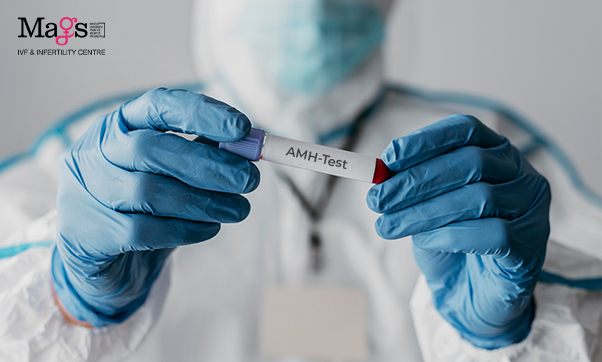
A commonly used test to assess ovarian reserve is the Anti-Müllerian Hormone (AMH) test. It helps fertility specialists understand how the ovaries may respond to fertility medications, particularly during treatments such as IVF.
However, many women have questions about what AMH levels mean, whether low AMH affects pregnancy, and when they should consider fertility testing.
If you are looking for an infertility clinic in Kolkata, understanding ovarian reserve and AMH testing can help you make informed decisions about your reproductive health. At MAGS IVF Centre, patients can seek professional guidance and personalised fertility assessments based on their medical history and individual requirements.
What Is Ovarian Reserve?
Ovarian reserve refers to the estimated quantity of eggs remaining in a woman’s ovaries at a particular point in her life.
Women are born with a limited number of eggs. This number naturally decreases with age as part of the reproductive ageing process. Unlike sperm production, which continues throughout much of a man’s life, women do not continuously produce new eggs.
Ovarian reserve is an important factor in fertility assessment because it helps doctors understand the potential number of eggs available for development during a menstrual cycle or fertility treatment.
It is important to remember that ovarian reserve does not directly measure egg quality or guarantee whether a woman can or cannot become pregnant naturally.
What Is AMH (Anti-Müllerian Hormone)?
Anti-Müllerian Hormone (AMH) is a hormone produced by the granulosa cells of small developing ovarian follicles.
An AMH blood test measures the amount of this hormone in the bloodstream. Since AMH levels are associated with the number of small follicles in the ovaries, the test is commonly used to estimate ovarian reserve.
Fertility specialists may recommend AMH testing as part of a broader fertility evaluation, particularly when:
- A woman is planning pregnancy and wants to understand her ovarian reserve.
- There are concerns about reduced ovarian reserve.
- A patient is preparing for IVF treatment.
- There is a history of irregular menstrual cycles or certain reproductive conditions.
- A doctor needs to estimate how the ovaries may respond to fertility medications.
The AMH test is a simple blood test. It can generally be performed on any day of the menstrual cycle, although the doctor may consider other investigations alongside the result.
Understanding AMH Levels: What Do They Indicate?
AMH levels are often used to estimate ovarian reserve. However, the interpretation depends on several factors, including age, laboratory methods, medical history and the overall fertility assessment.
A higher or lower AMH result does not independently determine a woman’s ability to conceive.
The following table provides a general overview of how AMH results may be interpreted.
| AMH Result | General Interpretation |
|---|---|
| Low AMH | May indicate a lower number of developing follicles and reduced ovarian reserve. |
| Normal AMH | May indicate an ovarian reserve within the expected range for the laboratory’s reference values. |
| High AMH | May indicate a higher number of developing follicles. It can sometimes be associated with Polycystic Ovary Syndrome (PCOS). |
Important: There is no single AMH range that applies to every woman. Results depend on the laboratory’s testing method, age and clinical circumstances. Your fertility specialist should interpret the report rather than relying on a number alone. ASRM+1
What Does Low AMH Mean for Fertility?
Low AMH levels may indicate that the ovaries have a smaller pool of developing follicles than expected. This condition is commonly described as diminished ovarian reserve.
However, a low AMH result does not automatically mean that a woman cannot become pregnant.
Some women with low AMH levels may conceive naturally, while others may require medical assistance depending on additional fertility factors.
Low AMH may have the following implications:
- Reduced ovarian response: The ovaries may produce fewer eggs during fertility stimulation.
- IVF treatment planning: Doctors may adjust medication dosages and stimulation protocols according to the patient’s ovarian reserve.
- Need for timely evaluation: Women planning pregnancy may benefit from discussing their reproductive goals with a fertility specialist.
- Individualised fertility care: Age, egg quality, reproductive health and other factors must be considered before recommending treatment.
It is important to understand that AMH mainly provides information about egg quantity, not egg quality. Female age remains a major factor when assessing reproductive potential. ASRM+1
Does High AMH Mean Better Fertility?
A higher AMH level does not necessarily mean better fertility or a higher chance of pregnancy.
High AMH levels may indicate a larger number of small developing follicles. In some women, particularly those with Polycystic Ovary Syndrome (PCOS), AMH levels may be elevated.
However, PCOS is a complex hormonal condition and cannot be diagnosed through an AMH test alone.
Women with high AMH levels may experience irregular menstrual cycles or ovulation-related difficulties, depending on the underlying condition.
A complete fertility assessment helps doctors understand what the result means and whether any treatment is required.
What Factors Affect Ovarian Reserve?
Ovarian reserve naturally changes throughout a woman’s reproductive years. Several factors may influence the number of eggs remaining in the ovaries.
1. Age
Age is one of the most important factors affecting ovarian reserve. The number of eggs gradually decreases as women grow older. Egg quality also declines with age, which can affect the chances of conception.
2. Genetics
Genetic factors can influence how quickly ovarian reserve declines. Some women may experience reduced ovarian reserve at a younger age due to inherited factors.
3. Medical Conditions
Certain medical conditions, including endometriosis, autoimmune conditions and some ovarian disorders, may affect ovarian function and reserve.
4. Previous Ovarian Surgery
Certain ovarian surgeries may affect healthy ovarian tissue and potentially reduce ovarian reserve, depending on the procedure and the underlying condition.
5. Cancer Treatments
Some cancer treatments, particularly chemotherapy and radiation involving reproductive organs, may affect ovarian function and egg quantity.
6. Family History
A family history of early menopause or premature ovarian insufficiency may be relevant when assessing reproductive health.
Understanding these factors can help women discuss their fertility concerns with a specialist and consider appropriate testing.
How Is Ovarian Reserve Tested?
AMH testing is one of the commonly used methods for assessing ovarian reserve. However, fertility specialists may recommend additional investigations to obtain a more complete understanding of reproductive health.
Here are some commonly used tests:
1. AMH Blood Test
The AMH test measures the concentration of Anti-Müllerian Hormone in the blood. It helps estimate the number of small developing follicles in the ovaries.
One advantage of this test is that it can generally be performed on any day of the menstrual cycle.
2. Antral Follicle Count (AFC)
Antral Follicle Count is performed through a transvaginal ultrasound.
During this examination, the fertility specialist counts the small follicles visible in both ovaries. This helps estimate ovarian reserve and predict the potential response to fertility medications.
3. Follicle-Stimulating Hormone (FSH) Test
FSH is a hormone produced by the pituitary gland that helps regulate ovarian function.
Doctors may measure FSH levels, generally on days 2–4 of the menstrual cycle, along with estradiol, to assess ovarian function.
4. Estradiol Test
Estradiol is a form of estrogen produced primarily by the developing ovarian follicles.
It is often measured alongside FSH during the early part of the menstrual cycle to help interpret ovarian reserve results.
These tests provide different types of information. A fertility specialist may recommend one or more of them depending on the patient’s medical history and fertility goals.